A new heating and cooling system is one of the bigger purchases you'll make for your home. The equipment matters, but how it's sized and installed matters just as much. A well-installed mid-range system often outperforms a high-end system that was put in poorly.
How does San Diego's climate affect the choice of system?
San Diego County covers a lot of different weather. Coastal neighborhoods have mild summers and cool, damp winters, and many older homes there were built without AC at all. Inland valleys get long, hot summers and much colder winter nights. Foothill and mountain areas can see real cold.
That means there's no single right answer:
- Coastal homes often do well with a heat pump or a modest system, since cooling needs are lighter.
- Inland homes benefit from higher cooling efficiency and good attic insulation, since the AC works hard for months.
- Homes with no ductwork, or additions and converted garages, are often a good fit for ductless mini-splits.
- Homes in colder areas may want a furnace or a dual-fuel setup that pairs a heat pump with a gas furnace.
Why does sizing matter so much?
Bigger isn't better. An oversized system cools the house fast, shuts off and starts again over and over. That short cycling wastes energy, wears out parts and does a poor job of removing humidity. An undersized system runs constantly and can't keep up on the hottest days.
Proper sizing uses a load calculation, often called a Manual J. It looks at square footage, insulation, windows, orientation, air leakage and local climate. If a contractor sizes your new system just by looking at the old one, ask how they arrived at the number.
What about the ductwork?
In most Southern California homes, the ducts run through the attic, where summer temperatures get extreme. Old ducts are often leaky, crushed or poorly insulated. Putting a new system on bad ducts is like putting new tires on a bent wheel.
A good installation includes a duct inspection and, where needed, sealing, repair or replacement. It also checks that there's enough return air, since too little return is one of the most common problems in older homes.
Do I need a permit and Title 24 testing?
Yes, HVAC replacement in California generally requires a permit from your city or the county. California's Title 24 energy code can also require duct leakage testing and verification by a third-party HERS rater on many system changeouts. Your contractor should pull the permit and coordinate inspections and testing. If someone offers to skip the permit, that's a red flag.
Permits protect you. They make sure the work meets code, and an unpermitted install can cause problems when you sell the home.
What does the installation process look like?
- Home visit and estimate. A technician looks at your current system, ducts, electrical and attic, and talks about comfort issues.
- Load calculation and equipment choice. You'll get options with different efficiency levels.
- Permit. The contractor files for the permit.
- Removal. The old equipment is removed, and refrigerant is recovered properly.
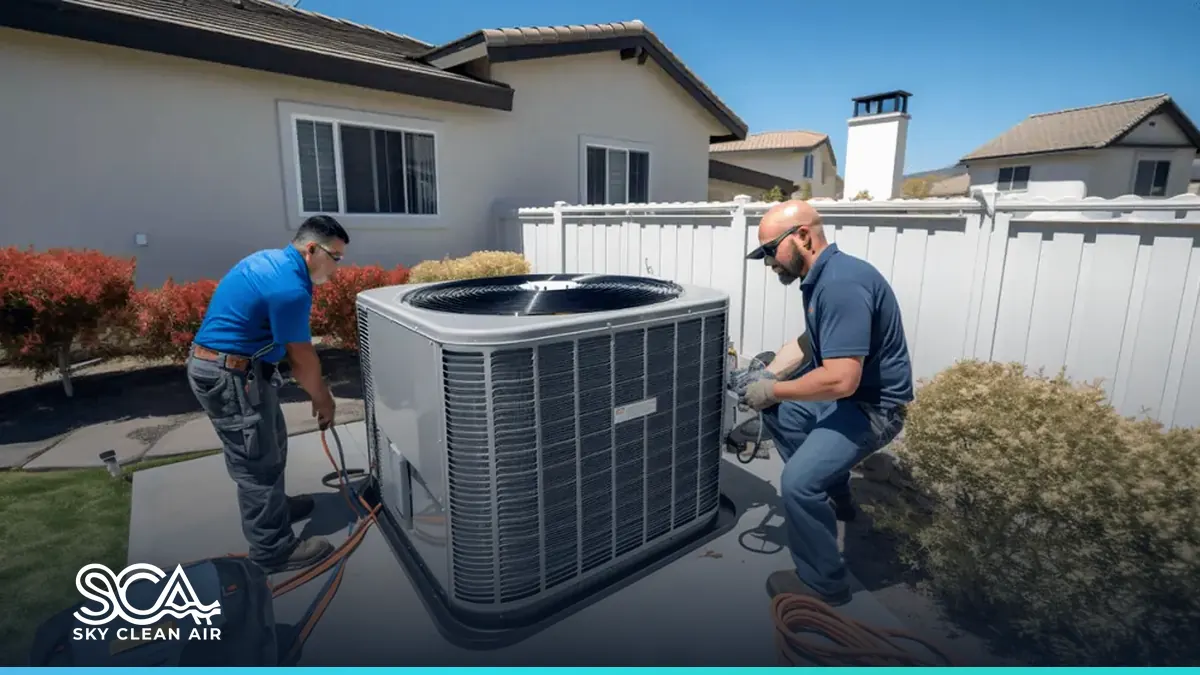
- Installation. New equipment goes in, along with any duct, electrical and drain work.
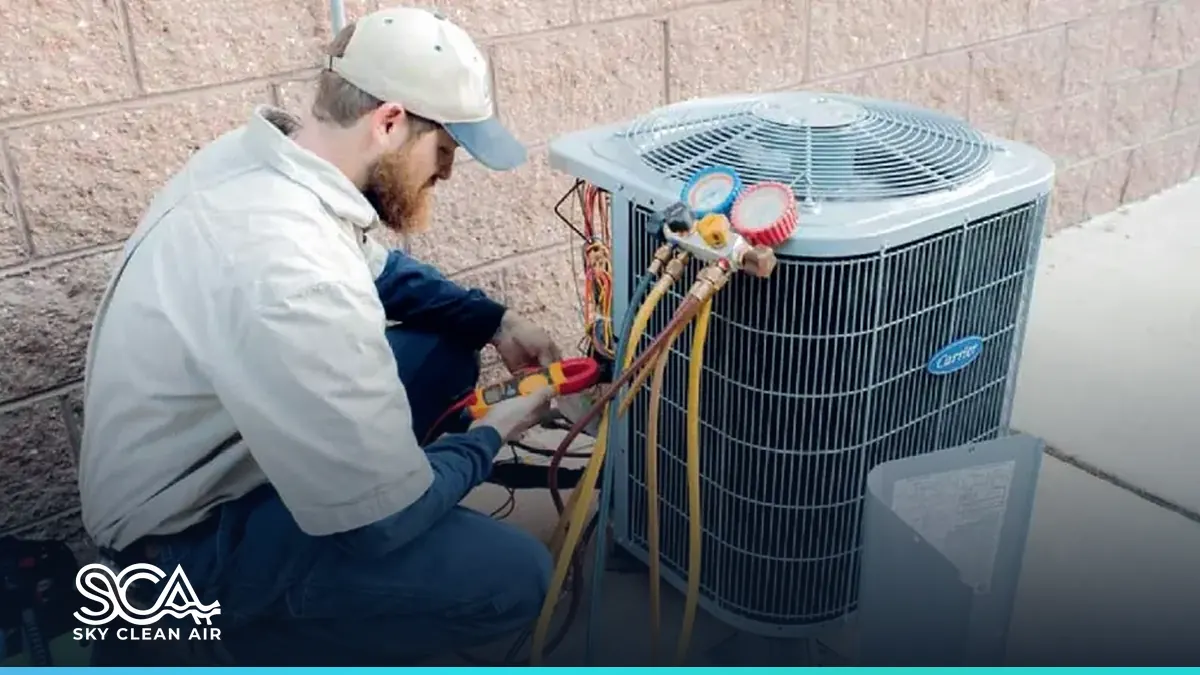
- Startup and testing. The system is charged, airflow is checked and safety controls are tested.
- Inspection and verification. The city or county inspects, and any required HERS testing is completed.
What should I ask before choosing an installer?
- Will you do a load calculation?
- Will you inspect and test the ductwork?
- Are you pulling the permit?
- What are the exact model numbers and efficiency ratings?
- Is the outdoor unit matched with the indoor coil or air handler?
- What refrigerant does the new system use? Newer systems use lower-impact refrigerants like R-454B or R-32.
- Who handles maintenance after the install?
Sky Clean Air holds California Contractor License #1036543 and installs furnaces, heat pumps, central air and mini-splits throughout San Diego County and Orange County. Learn more about our HVAC installation service, or contact us to set up a free estimate.